
 Sep
17
Sep
17
Easy Tips for Selling Home Quickly: 7 Proven Moves
- September 17, 2026
- 0 Comment(s)
Table of Contents
- Why Small Fixes Beat Big Renovations When Selling Home Quickly
- Price It Right From Day One
- Best Home Improvements for Resale Value (That Cost Little)
- How to Clean Tile and Grout for Open Houses
- Home Staging Tips for Quick Sale
- Curb Appeal and Photography: First Impressions Online
- The Angles Most Sellers Miss: Inspections, Virtual Tours, and Fast Negotiation
- Conclusion
- Frequently Asked Questions
Last Updated: September 16, 2026
Why Small Fixes Beat Big Renovations When Selling Home Quickly
Selling home quickly is rarely about the biggest renovation. It is about removing the small objections that make buyers hesitate, and grimy grout is one of the loudest. This guide from Grout Shield Distributors covers the seven moves that consistently shorten time on market, starting with the cheapest ones.
Kitchen and bathroom tile is where buyers unconsciously judge maintenance. Dark, discolored grout lines read as neglect, even when the tile itself is fine. A full regrout is slow and disruptive; a targeted grout restoration is neither.
Here is the core argument of this article: speed comes from fixing what buyers see first, not from spending the most money. The National Association of Realtors 2025 Profile of Home Buyers and Sellers confirms that buyers weigh a home’s overall condition heavily when deciding whether to make an offer at all.
So before you price, paint, or stage, walk your own kitchen floor and look down.
Price It Right From Day One
Overpricing costs more time than any other single mistake. A home that sits past the first few weeks of interest attracts lower offers, not higher ones, buyers assume something is wrong with a listing that has gone stale, and their agents will use your days-on-market count as leverage against you.
Pricing correctly means anchoring to recent comparable sales in your immediate area, not to what you hope the market will bear. Ask your real estate agent for a market analysis covering the last 90 days, then price at fair market value rather than testing a higher number first. The first two weeks on market generate the most showing traffic you will ever get; wasting them on an aspirational price is the single most expensive mistake in the process.
Psychological Pricing That Draws Offers
Round numbers signal a seller who guessed. Precise numbers signal a seller who did their homework, and they change which buyers ever see your listing at all.
Most buyers search in round increments. A buyer who types “$400,000” into a search filter typically sees everything priced at $400,000 and below. A home listed at $399,900 appears in that search; a home listed at $400,000 may not, depending on how the platform rounds. That single digit is the difference between being in the result set and being invisible.
Three tactics worth applying:
- Price just under a search threshold. If comparable sales cluster near $400,000, list at $399,900 rather than $400,000. You capture every buyer searching up to the round number.
- Use a precise, non-round figure. A price like $397,500 reads as calculated. A price like $400,000 reads as a guess. Buyers and their agents treat the two very differently during negotiation.
- Avoid pricing into a higher band. Crossing a $25,000 or $50,000 search increment can drop you out of the results a buyer is actually browsing, even if the dollar difference is small.
The effect on any single listing is modest, but it costs nothing to apply and it compounds with every other speed tactic in this guide.
Ask your agent to pull the search-filter increments buyers actually use in your price range, then price one dollar below the nearest one. It is the cheapest exposure boost available.
Best Home Improvements for Resale Value (That Cost Little)
The best home improvements for resale value are the ones buyers notice immediately and that cost you the least. Cosmetic fixes beat structural projects almost every time.
Buyers walk in expecting a project-free home. Anything that looks tired becomes a negotiating chip against you.
Prioritize in this order:
- Grout and tile appearance. Discolored grout makes clean tile look dirty.
- Fresh caulk in kitchens and baths. Cracked caulk reads as water damage.
- Light switch plates and outlet covers. Cheap to replace, instantly noticeable.
- Cabinet hardware. A fast swap that modernizes a dated kitchen.
- Interior paint in neutral tones. The single highest-return cosmetic job.
Notice what is missing from that list: new floors, new counters, new cabinets. Those are the improvements that eat your margin without shortening your time on market.
Grout Restoration: The Overlooked Value Booster
Grout restoration is the rare improvement that changes a room’s perceived condition without changing the room. Instead of tearing out tile, you clean, recolor, and seal the grout lines already there.
Place An Order Online or Call 1-800-631-0716 →
At Grout Shield Distributors, we have supplied professional-grade grout restoration and coloring products since 1996, and the pattern is consistent: homeowners preparing to sell get the biggest visual gain from the smallest surface area. A color-matched grout line makes an older floor read as maintained rather than worn.
The alternative, regrouting, means removing and replacing grout across the entire floor. That is labor-intensive, disruptive, and usually unnecessary when the tile itself is sound.
Match the new grout color to the existing grout, not to the tile. A color-matched line looks original; a contrasting line looks like a repair.
How to Clean Tile and Grout for Open Houses
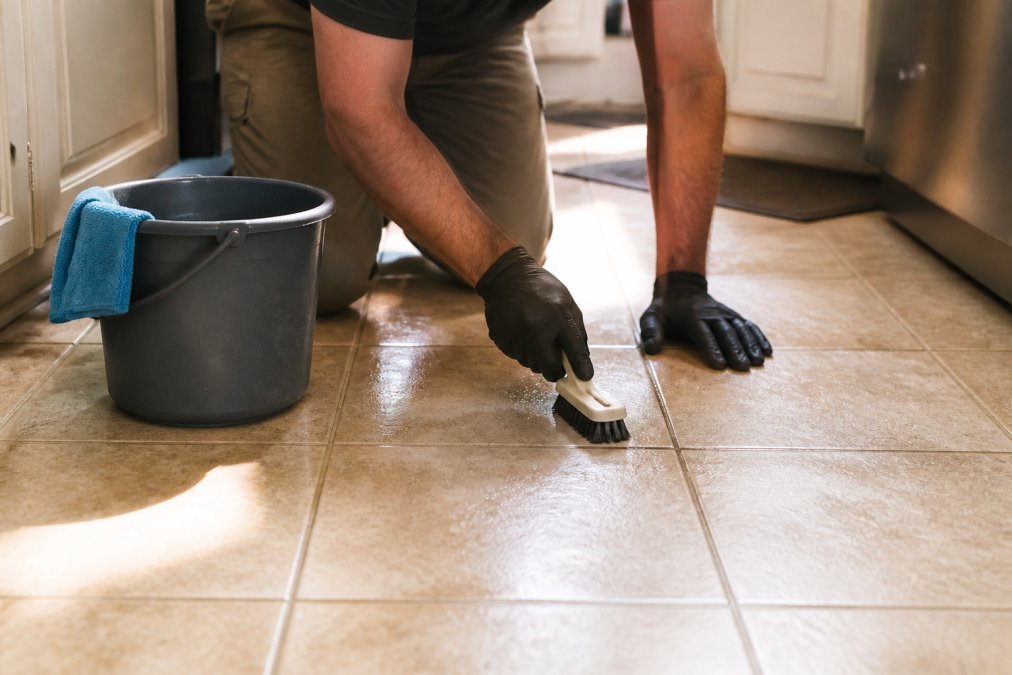
Cleaning tile and grout for open houses is a two-part job: strip the soil first, then seal so it stays clean through repeated showings. Skipping the seal is why so many sellers re-clean the same floor the night before every visit.
A Step-by-Step Grout Refresh Routine
- Vacuum the grout lines dry. Loose grit turns into muddy paste when you wet it.
- Apply a grout cleaner and let it dwell. Give it the full dwell time on the label; scrubbing too early wastes product.
- Agitate with a stiff brush, not steel wool. Steel wool scratches glazed tile.
- Rinse and blot, do not flood. Standing water pushes soil back into the lines.
- Let it dry completely, then seal. Sealer over damp grout traps moisture underneath.
- Buff off excess sealer after it cures. Leftover sealer dries as a film.
- Re-clean lightly the morning of the open house. A dry mop is usually enough.
Two days before the open house is the right time to do this. Not the morning of.
Do not seal grout that still has active mold or mildew underneath. You will trap the stain and it will reappear, sometimes within weeks, right when buyers are walking through.
Home Staging Tips for Quick Sale
Staging works because it lets buyers imagine themselves living there. The fastest staging wins come from subtraction, not decoration, and the goal is not a prettier house, it is a shorter decision.
A Room-by-Room Subtraction Checklist
Staging for speed is mostly removal. Work through this list before your first showing:
- Kitchen: Clear the counters except one bowl or board. Remove magnets, notes, and small appliances you do not use daily.
- Bathrooms: Put away every personal product. Fold towels uniformly. A single small plant or candle is enough.
- Bedrooms: Neutral bedding, no laundry visible, nothing stored under the bed. Buyers look.
- Living room: One object per surface. Remove family photos, throw blankets that look worn, and any furniture that blocks the walking path.
- Entry: Shoes, coats, and mail out of sight. The entry sets the tone for the whole tour.
The Showing-Day Reset
Staging is not a one-time event. It is a routine you repeat before every showing, because buyers schedule with little notice and a home that looks staged in photos but lived-in in person reads as a bait-and-switch.
Staging is not about adding furniture. It is about removing the evidence that a specific family lives there, so the buyer’s decision is not slowed by someone else’s life.
Curb Appeal and Photography: First Impressions Online
Most buyers see your home online before they ever see it in person, so your listing photos are the real front door. Curb appeal and photography are the same job done twice.
The Angles Most Sellers Miss: Inspections, Virtual Tours, and Fast Negotiation
Three moves separate sellers who close fast from sellers who sit. Most guides skip all three.
| Seller Move | Time Cost | Typical Effect on Speed |
|---|---|---|
| Grout cleaning and sealing | 1 weekend | Removes a visible objection |
| Pre-listing inspection | 1-2 weeks | Prevents renegotiation stalls |
| Virtual tour | 1-3 days | Widens the buyer pool |
| Flexible closing date | None | Makes your offer easier to accept |
| Depersonalizing and decluttering | 1 weekend | Speeds buyer decisions |
Ask your agent to request a flexible showing schedule and same-day notice. Buyers who cannot get in quickly often move on to the next listing.
Conclusion
The hard part of selling home quickly is not the work itself, it is knowing which work actually shortens time on market and which work just costs money. Most sellers spend on the wrong surfaces and leave the visible ones untouched.
Frequently Asked Questions
What is the fastest way to sell a house?
The fastest path combines correct pricing, a clean and staged interior, strong listing photos, and flexible showing times. Small cosmetic fixes like refreshing grout, decluttering, and boosting curb appeal help buyers say yes sooner. A pre-listing inspection can also remove surprises that delay closing. In most markets, homes that are showing-ready from day one attract more offers in the first two weeks.
Does refreshing grout help sell a house faster?
Yes. Stained or discolored grout makes kitchens and bathrooms look dated and dirty, even when the tile itself is fine. Cleaning and recoloring grout gives those rooms a fresh, well-maintained look that shows up clearly in listing photos. Buyers touring an open house notice clean grout lines, and that small detail signals the whole home has been cared for.
What home improvements add the most value for resale?
High-return projects are usually the low-cost cosmetic ones: fresh paint, updated light fixtures, curb appeal work, and grout restoration in kitchens and baths. These fixes cost far less than a full remodel but change how buyers perceive the home. Deep cleaning, decluttering, and depersonalizing also add perceived value because they let buyers picture themselves living there.
How much does curb appeal affect home sales?
Curb appeal sets the first impression before a buyer ever steps inside. A tidy lawn, clean walkway, fresh paint on the front door, and well-lit entry make the home look maintained and move-in ready. Buyers often decide within seconds whether they want to see more, so this is one of the easiest and most affordable ways to increase showing requests and speed up offers.