 Nov
23
Uzin vs NuGrout: Which Holds Up for Contractors
- November 23, 2026
- 0 Comment(s)
Last Updated: November 4, 2026
Quick Summary
For contractors comparing uzin vs nugrout, the right choice depends on the job rather than one product winning everywhere. Match the system to the substrate, joint width, moisture exposure and working conditions, then test on an inconspicuous joint before committing.
- Cementitious grout cures by hydration, while colorant systems cure as polymer particles fuse into a continuous film.
- Polymer-modified products tolerate more substrate movement and are common in wet areas.
- Always check the current technical data sheet for each system before committing to a job.
- Mixing cementitious grout with extra water to stretch working time weakens the cured matrix.
- Clean, fully dried joints with old sealers removed are essential for colorant adhesion.
Table of Contents
- Why Contractors Compare Uzin and NuGrout
- How Uzin and NuGrout Differ in Formulation
- Professional Grout Colorant Application: Side by Side
- Grout Color Matching for Contractors
- Durability, Sealing and Long-Term Performance
- Grout Restoration Best Practices and Required Tools
- Choosing the Right System for Your Next Job
- Frequently Asked Questions
Why Contractors Compare Uzin and NuGrout
Grout Shield Distributors has spent decades helping homeowners and contractors restore tile surfaces, and the question of which professional system to trust comes up constantly. Contractors comparing uzin vs nugrout for contractors are usually weighing three things: how the product performs on the job, how long the result lasts, and whether it fits the way their crews already work.
Neither system is a cosmetic afterthought. Both are aimed at professionals who need consistent color, reliable sealing and a finish that holds up after the client has moved on. That is why the comparison matters on real job sites, not just on a product sheet.
This guide walks through the differences that affect day-to-day work. We keep the focus on practical trade-offs rather than marketing claims, so you can judge each option against your own projects.
How Uzin and NuGrout Differ in Formulation
The first difference contractors notice is the base chemistry, and it is worth being specific about what that means on a job site. The two systems sit in different product families, and the binder choice drives workability, curing behavior, adhesion and how the finished joint responds to moisture and traffic.
A cementitious grout cures by hydration: Portland cement reacts with water to form a crystalline matrix, and the joint gains strength as that matrix develops. A polymer-modified grout adds a redispersible polymer or latex component that forms a flexible film within and around the cement matrix, improving adhesion to the joint walls and tolerance to minor movement. A grout colorant or coating system is generally a waterborne dispersion that cures by coalescence as the water evaporates and the polymer particles fuse into a continuous film. That film-forming mechanism is why surface preparation and dryness matter so much for colorant systems.
Those mechanisms produce different trade-offs in the field:
- Working time and pot life. Cementitious mixes have a defined pot life once water is added and begin to set on a predictable curve; polymer dispersions stay workable longer but skin over if left open in a dry, warm room.
- Cure and return to service. Cementitious grout needs moisture to cure and is sensitive to rapid drying; polymer films need adequate coalescing conditions, which generally means staying within the manufacturer’s temperature range and avoiding application in direct sun or high airflow.
- Movement accommodation. Polymer-modified systems tolerate more substrate movement than unmodified cementitious grout, which is why they are common in wet areas and over substrates that see deflection.
- Stain and moisture resistance. A cured polymer film is inherently less porous than cementitious grout, so it resists liquid penetration better, but only if the film is continuous and the joint was properly prepared.
Because product specifications change over time, always check the current technical data sheet for each system before you commit to a job.
Cementitious vs. Polymer-Modified Options
Cementitious formulations rely on Portland cement and are the traditional choice for many grout applications. They are widely understood by installers and tend to be straightforward to work with on standard joints, but unmodified cementitious grout is porous and benefits from sealing.
Polymer-modified formulations add a latex or polymer component to improve flexibility, stain resistance and adhesion. Many contractors choose polymer-modified products for wet areas and for substrates that see movement. The trade-off is that they can be less forgiving during application and may require closer attention to temperature and curing conditions.
Knowing which category a given product falls into helps you match it to the substrate, the joint width and the environment the floor or wall will face. As a rule of thumb, match the system to the joint: narrow joints and dense porcelain favor a finer, more flowable product, while wider joints and natural stone favor a mix that packs without shrinking and that will not scratch or stain the stone face.
Watch out: Mixing a cementitious product with more water than the data sheet allows to stretch working time weakens the cured matrix and is one of the most common causes of powdery, failing grout.
Professional Grout Colorant Application: Side by Side
Applying a grout colorant looks simple, but technique separates a clean, even result from blotchy joints. The process generally involves surface preparation, a controlled application and a careful cleanup before the product cures.
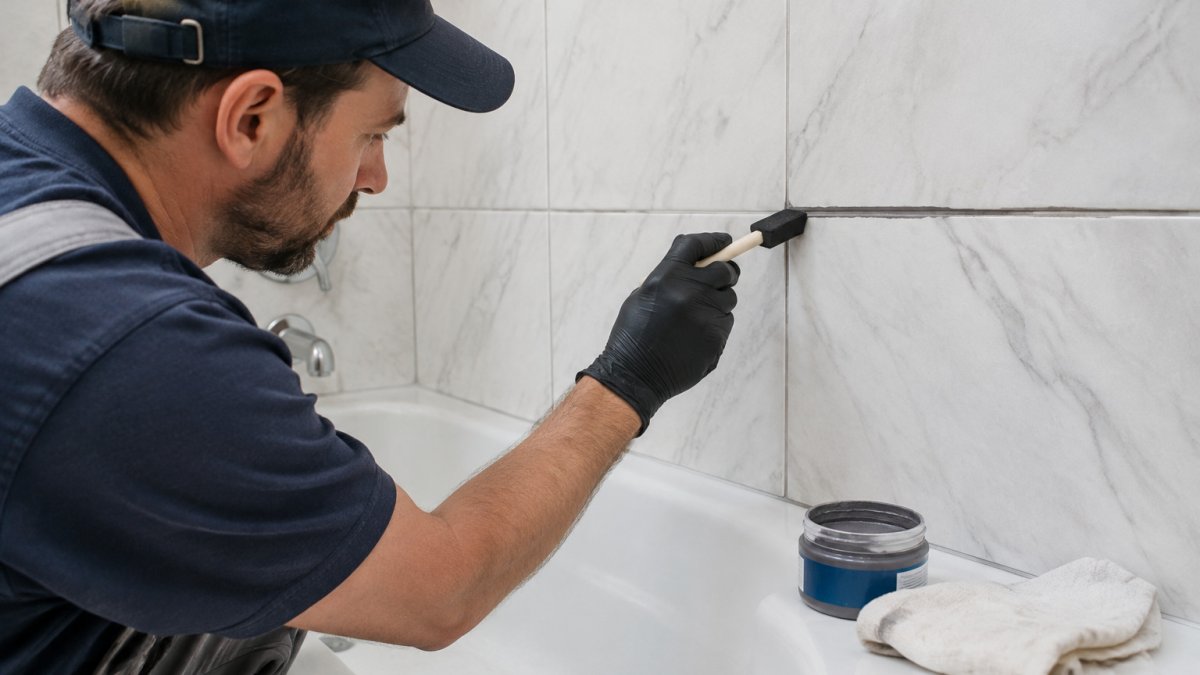
Preparation comes first. Joints should be clean, dry to the manufacturer’s recommended level and free of old sealers that could block adhesion. Mask adjacent tile and fixtures, since colorant that dries on a glazed surface can be difficult to remove.
When comparing the two systems side by side, focus on these application points:
- Working time: How long you have to apply and wipe before the product begins to set.
- Coverage rate: How much area a unit of product covers at the stated joint width.
- Cleanup method: Whether haze or excess material comes off with a damp sponge or requires a specific cleaner.
- Number of coats: Whether a single pass achieves the target shade or a second coat is needed for full coverage.
Watch out: Applying colorant to joints that have not been fully dried or cleaned is one of the most common reasons for uneven color. Skipping the prep step rarely saves time once you factor in rework.
The steps below summarise how a grout colorant is applied, from preparation through cleanup.
| Step | What to do | Key point |
|---|---|---|
| Preparation | Clean joints, dry to recommended level, remove old sealers | Prevents adhesion failure |
| Masking | Mask adjacent tile and fixtures | Dried colorant on glazed tile is hard to remove |
| Working time | Apply and wipe within the stated window | Product begins to set over time |
| Coverage check | Confirm coverage at the stated joint width | Covers a set area per unit |
| Coats | Apply one or more coats to reach target shade | Single pass may not give full coverage |
| Cleanup | Remove haze with a damp sponge or specific cleaner | Excess must come off before curing |
Grout Color Matching for Contractors
Color matching is where many jobs succeed or fail. Existing grout has aged, may have picked up stains, and rarely matches the original swatch. Experienced contractors test on an inconspicuous joint before committing to the full floor or wall.
Place An Order Online or Call 1-800-631-0716 →
Start by identifying whether the existing grout is sanded or unsanded, since texture affects how colorant sits in the joint. Then compare your test patch under the same lighting the finished room will have, not only under the job-site work light.
Grout Shield Distributors offers over 200 colors along with custom color-matching services. Contact the team directly for current color options and matching support, as availability and turnaround can vary.
Durability, Sealing and Long-Term Performance
Clients judge a grout job by how it looks months later, not on the day it is finished. Durability depends on the colorant or grout system itself, the sealer applied over it, and the conditions the surface endures afterward. It helps to frame durability in terms contractors can evaluate on their own projects.
What drives long-term performance. Three factors dominate: adhesion of the system to the prepared joint, continuity of the protective film or sealer, and the cleaning regimen the client follows. A colorant that bonded well but was sealed too soon, or cleaned with an acidic product, will fail earlier than one that was applied to a properly dried joint and maintained with pH-neutral cleaner. In high-traffic settings, gradual wear at the highest-abrasion points, entryways, kitchen lines and chair-leg zones, is a common concern, where the film can thin and staining may begin to show.
Sealing and compatibility. Sealing protects against staining and moisture intrusion, particularly in kitchens and bathrooms. Check the sealer compatibility requirements for each system, because some colorants require a specific sealer or a minimum cure period before sealing.
Framing the ROI decision. Contractors comparing a restoration system against full replacement need a cost-per-square-foot view rather than a per-unit price. The comparison that matters is total installed cost, material, labor hours per square foot, prep time and the expected service life before the next intervention, divided by the years of service that buys.
Maintenance and handoff. Long-term performance also depends on maintenance. Recommend that clients use pH-neutral cleaners and avoid harsh abrasives, which can gradually wear the protective layer. Setting these expectations at handoff reduces callbacks and protects the warranty relationship with the manufacturer. Documenting the products used and the date of application helps a future crew match the system.
For guidance on keeping grout surfaces in good condition, the Tile Council of North America publishes installation and maintenance standards that many professionals reference, at Tile Council of North America installation handbook.
Grout Restoration Best Practices and Required Tools
Restoration jobs typically demand more preparation than new installations. Old grout may be porous, stained or partially deteriorated, and it needs to be cleaned and assessed before any colorant goes on.
A typical restoration toolkit includes a stiff brush or grout-cleaning tool, a shop vacuum, clean sponges, microfiber cloths, masking tape, a small foam or applicator brush, and protective gloves and eyewear. Keep a supply of clean water and rags nearby for cleanup passes.
Best practice is to clean the grout thoroughly, allow it to dry completely, and inspect for cracks or missing sections. Any damaged joints should be repaired before colorant is applied, because color will not hide structural problems.
A common mistake is rushing the drying stage. Trapped moisture can interfere with adhesion and cause the colorant to fail prematurely.
Choosing the Right System for Your Next Job
There is no single answer to which system holds up best across every project. The right choice depends on the substrate, the joint width, the moisture exposure, the color target and the working conditions on your site.
Use these questions to narrow your decision:
- Is the area wet, such as a shower or tub surround, or is it a dry floor?
- Does the existing grout need a close color match, or is a deliberate color change the goal?
- How much working time does your crew need, given the size of the area?
- Will the finished surface see heavy traffic or regular cleaning with strong products?
Contractors who answer these questions before ordering materials tend to avoid surprises. Pricing depends on quantity, dates and delivery, so for current pricing, product availability or a quote tailored to your project, place an order online at Grout Shield Distributors or call 1-800-631-0716 to speak with the team.
Frequently Asked Questions
What are the primary differences between Uzin and NuGrout for professional tile restoration?
Uzin is widely known for professional flooring adhesives, leveling compounds and installation systems, while NuGrout is a grout colorant and restoration product sold for recoloring existing grout lines. For restoration work, the practical question is whether you need a new grout bed or a recolored surface. Compare the product data sheets for coverage rate, curing time and surface prep requirements on your specific job before committing to either system across a full project.
Can contractors use Uzin and NuGrout interchangeably on commercial projects?
Not as direct substitutes. They serve different stages of work: installation and substrate products versus color restoration and sealing. Many contractors use a bonding or prep product for installation and a colorant for restoration as separate line items. Confirm each product’s intended use in the manufacturer’s documentation and check any project specifications that call for a named system.
How does NuGrout compare to traditional grout sealers for durability?
A grout colorant and a clear sealer serve different purposes, so the right choice depends on whether you need a color change or only protection. A clear sealer protects against stains but does not change color. Durability depends on surface prep, application thickness and traffic levels. Ask for current performance details and test a small area before committing to a full-room job.
What is the expected lifespan of a NuGrout application compared to Uzin products?
Lifespan depends on traffic, cleaning routine, substrate condition and how well the product was applied, so no single figure applies to every job. Because Uzin and NuGrout serve different functions, comparing their lifespans directly is less useful than comparing each product’s rated performance for your application. Request the current technical data for the exact product you plan to use.
